Week 24 - Finding your optimal performance zone
This week, Tyler discusses how people can find their optimal arousal so they can perform at their best.

Hello everyone! Thanks for reading another episode of the newsletter.
I’m going to start with a thought experiment: I want you to think about a situation in your life where you have performed at a high level. It could be an important presentation at work, a big game, or examination in school. Reflecting on these experiences, what was your emotional level during these performances? Were your emotions high (e.g., anxious, nerves) or low (e.g., relaxed, calm)? When you consider other events in which you have performed at a high level, were your emotions or arousal similar or did it potentially change depending on the task at hand? This week, I am going to be discussing how you can find your optimal arousal so you can perform at your best.
The Yerkes-Dodson law is a theory that suggests that there is an optimal level of arousal to obtain optimal performance (Teigen, 1994). The law suggests that optimal performance somehow lies between high and low levels of arousal. For instance, prior to a championship game, players would need to find an arousal halfway between crippling anxiety and boredom to perform at their best. While the theory accurately notes a specified level of arousal is key to achieving high performance, I respectfully believe they are missing some key factors that have not been taken into account.
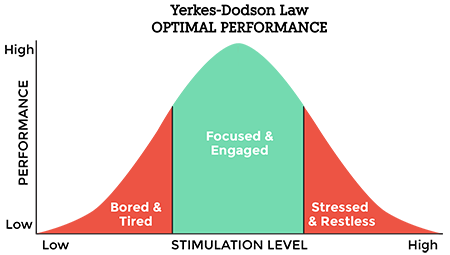
First, the Yerkes-Dodson law doesn’t consider individual differences when determining optimal arousal level. For instance, some individuals are naturally at either a higher or lower arousal level. Higher energy people may need to be at a higher arousal to perform well, whereas those who are low energy may need to be at a lower arousal to perform well. In my view, the individual needs to know what works best for them to perform optimally. If they require lower stimulation to perform well? Great. If they require being at a higher stimulation to perform well? Great. It doesn’t matter that the law suggests that to perform at one’s best they can’t be too high or too low. The important thing is to recognize what this level is for each of us and to find ways to get there.
Secondly, the Yerkes-Dodson law doesn’t consider sport-specific differences in optimal arousal. Depending upon the sport in which a person is competing, this could change the level of arousal required to reach optimal performance. Take equestrian and Olympic weightlifting for example. In equestrian, the jockey would likely need to keep their arousal level lower to prevent the horse from feeling their energy. If the jockey’s arousal is too high, this could get transferred to the horse and may limit performance. In Olympic weightlifting, the lifter will often need to get themselves to a point of higher arousal to become energized and make the lift. Think about lifters standing over the bar during the Olympics. They sometimes even yell prior to their lift, and this is to ensure they reach a high enough activation before making the movement. If their arousal is too low, they may lack the required energy and miss their lift. I’m sure you can think of several other sports that require differing levels of arousal. Figure skating and curling likely both require lower activation, whereas martial arts and football likely require higher activation. While this critique was predominantly related to sport, I believe it can extend further into task-specific differences in optimal arousal. There are certain tasks which may require differing levels of arousal to reach optimal performance. During an important job interview or presentation, depending upon the person they may require differing levels of arousal. For myself, I need to stay somewhat neutral, but for somebody else they may need to be higher or lower. The point is to consider the task you are doing and to find the level of activation you need to perform at your best. Not everyone is the same. Find what works best for you.
At the end of the day, there are general guidelines to optimal arousal that would enable people to perform at their best. For the most part, you don’t want to be too high or too low. However, this isn’t always the case. I want you to reflect on what your arousal needs to be to perform at your best. Maybe you need to be more on the high or low ends, or maybe you need to be right in the middle. Your arousal level could also be very different depending upon the situation too. Ultimately, find what works for you in a given situation. Use practice and preparation as an opportunity to find what works. The more often you are capable of hitting your optimal arousal zone, the more likely you are to perform at a high level at any given moment.
Question: What does your arousal need to be to perform at your best?
Thank you for reading.
Until next week,
Tyler
Twitter: tcmakepeace
Website: tylermakepeace.substack.com
Instagram: tylertalks.blog
References:
Teigen, K. H. (1994). Yerkes-Dodson: A law for all seasons. Theory & Psychology, 4, 525-547.
ICYMI: Check out last week’s article below!
I usually require excitement, energy and a nervous belly heading into the situation or performance. Once I am in there things begin to settle and a sense of calm happens if I feel prepared.
If it is a situation or performance that I am unprepared for all the same things occur but the sense of calm is never achieved.